
Deaf Awareness Week: learn some BSL with us
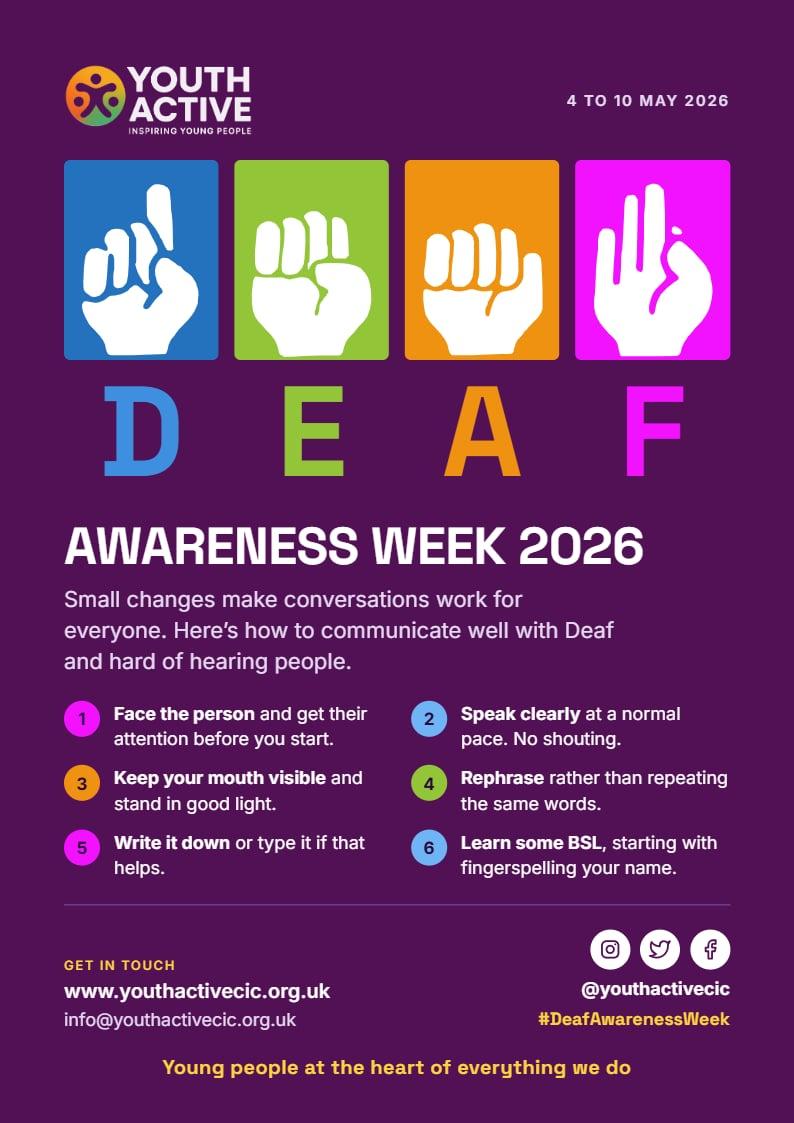
Deaf Awareness Week ran from 4 to 10 May 2026. The message is one for all year round: small changes make conversations work for everyone. Here are simple tips, and nine British Sign Language (BSL) signs young people can learn today.
Deaf Awareness Week takes place every May. It raises awareness of deafness and celebrates Deaf culture, community and history. In 2026 the National Deaf Children’s Society (NDCS) focused on spotting the signs of deafness early, so that deaf children get the right support sooner.
Around half of deaf children in the UK are born deaf. The other half become deaf later in childhood. Signs such as not answering when called, preferring to play alone, or getting frustrated with instructions can be mistaken for something else, so it helps when everyone knows what to look out for.
At Youth Active we want every young person to feel included at every session. Being deaf aware, and knowing a few signs, is one of the easiest ways to make that happen.
4–10 May
Deaf Awareness Week 2026
1 in 2
deaf children are born deaf; the rest become deaf later
2022
BSL recognised as a language in law in Great Britain
Six ways to communicate well with Deaf people
- 1
Face the person and get their attention before you start, with a wave or a gentle tap on the shoulder.
- 2
Speak clearly at a normal pace. No shouting: it changes the shape of your lips and makes lipreading harder.
- 3
Keep your mouth visible and stand in good light, not with a bright window behind you.
- 4
Rephrase rather than repeating the same words. A different word may be easier to lipread.
- 5
Write it down or type it on your phone if that helps.
- 6
Learn some BSL starting with the signs on this page and fingerspelling your name.
Nine BSL signs to learn today
Try these with a friend or at home. Use your dominant hand (the one you write with) for one-handed signs, and remember your face matters as much as your hands: expressions are part of BSL.
Hello
Hold a flat hand by the side of your forehead and move it outwards, like a small salute. A friendly wave works too.
Make eye contact and smile: that is part of the greeting.
Thank you / please
Touch your chin with the fingertips of a flat hand, then move your hand forwards and down, towards the person.
In BSL the same sign is often used for both.
Yes
Make a fist and nod it up and down, as if your hand is nodding its head.
Nodding your head at the same time makes it even clearer.
Good
Make a fist with your thumb pointing up: a thumbs up.
Two thumbs up, or a bigger movement, means really good.
Bad
Make a fist with just your little finger pointing up.
Your face shows how bad: a small frown or a big one.
Friend
Clasp your hands together in front of you, as if shaking your own hand, and give them a small shake.
A great one to teach your teammates.
Help
Rest a thumbs-up fist on the flat palm of your other hand, then lift both hands up together.
Useful at any session, from football to Arts & Craft.
Deaf
Touch your ear with your first two fingers held together.
Many Deaf people use a capital D to show they are part of the Deaf community.
Name
Hold your first two fingers together, touch them to the side of your forehead, then move your hand away.
Follow it by fingerspelling your name (see below).
Signs are easiest to learn by watching them. Like spoken English has accents, BSL has regional signs, so you may see small differences. You can watch every sign here on SignBSL or BSL SignBank.
Fingerspell your name
BSL fingerspelling uses two hands. It is used for names, places and words that do not have a sign. The vowels are the easiest place to start: hold up your non-dominant hand, fingers spread, and point to a fingertip with the index finger of your other hand.
A
thumb
E
index finger
I
middle finger
O
ring finger
U
little finger
Once you know the vowels, look up the rest of the alphabet and practise spelling your own name. Then try it with the sign for name: “Hello, my name is…”
Everyone is welcome at Youth Active
Our sessions are free for young people aged 3 to 18, whatever their background or ability. If your child is deaf or hard of hearing, let us know when you register, or contact us, and tell us what helps them most. We will make sure our coaches and volunteers are ready.
Want to come along? See our free weekly sessions.